Showing posts with label petroleum. Show all posts
Showing posts with label petroleum. Show all posts
January 25, 2012
Free Download eJournal : Interpretation of Three-Dimensional Seismic Data, sixth ed. (AAPG Memoir No. 42 & SEG Investigations in Geophysics No. 9)
Free Download eJournal : Interpretation of Three-Dimensional Seismic Data, sixth ed. (AAPG Memoir No. 42 & SEG Investigations in Geophysics No. 9)
download : here
Keywords : Free Download eJournal : Interpretation of Three-Dimensional Seismic Data, sixth ed. (AAPG Memoir No. 42 & SEG Investigations in Geophysics No. 9), aapg memoir download
download : here
Keywords : Free Download eJournal : Interpretation of Three-Dimensional Seismic Data, sixth ed. (AAPG Memoir No. 42 & SEG Investigations in Geophysics No. 9), aapg memoir download


January 23, 2012
Free Download eJournal : Giant Hydrocarbon Reservoirs of the World (AAPG Memoir No. 88)
Free Download eJournal : Giant Hydrocarbon Reservoirs of the World (AAPG Memoir No. 88)
download : here
Keywords : Giant Hydrocarbon reservoirs, Free Download eJournal : Giant Hydrocarbon Reservoirs of the World (AAPG Memoir No. 88), AAPG Memoir Free Download
download : here
Keywords : Giant Hydrocarbon reservoirs, Free Download eJournal : Giant Hydrocarbon Reservoirs of the World (AAPG Memoir No. 88), AAPG Memoir Free Download
December 23, 2011
Neutron Log & Density Log
Neutron Log & Density Log
Neutron logs are logs that are used to measure the hydrogen index contained in the rock formation. Hydrogen index is the ratio of the concentration of hydrogen atoms / cm cubic of rock on the content of pure water at 75 F. Neutron log is not really measure the porosity, but measure the hydrogen index in the pores of rocks.
The more porous rock, the more higher the hydrogen content and hydrogen index. Thus, rocks that contain lots of hydrogen can be interpreted to have high porosity as well. In practice the interpretation of porosity can be done with collaboration of neutron log with density log.
Density logging was conducted to measure the density of the rock along the borehole. Density is measured the overall density of the rock matrix and the fluid contained in the pore. The working principle of the tool is the emission of radioactive sources. The more dense rocks the more harder radioactive rays and fewer emissions of radioactive emissions are calculated by the receiver (counter).

Merging neutron porosity log and density porosity log are very useful for detecting gas in the reservoir zone. Gas zones are indicated by 'cross-over' between the neutron and density logs.
In the picture above looks at the reservoir zone (low gamma ray), there is a 'cross-over' between the density and neutron. , in this case the neutron porosity lower than the density porosity.
Keywords: neutron log, density log, density log, well log, log, Neutron Log & Density Log
Reference:
John T. Dewan, "Open-Hole Nuclear Logging - State of the Art" - SPWLA Twenty-Seventh Annual Logging Symposium, June 9-13 1986.
http://ensiklopediseismik.blogspot.com/2009/02/neutron-porosity-dan-density-logging.html
Surjono, S.S., Sarju Winardi., D.H.Amijaya.2010. Analisis Sedimentologi, Pustaka Geo, Yogyakarta
Harsono, Adi. 1994. Pengantar Evaluasi Log. Schlumberger. Jakarta
Neutron logs are logs that are used to measure the hydrogen index contained in the rock formation. Hydrogen index is the ratio of the concentration of hydrogen atoms / cm cubic of rock on the content of pure water at 75 F. Neutron log is not really measure the porosity, but measure the hydrogen index in the pores of rocks.
The more porous rock, the more higher the hydrogen content and hydrogen index. Thus, rocks that contain lots of hydrogen can be interpreted to have high porosity as well. In practice the interpretation of porosity can be done with collaboration of neutron log with density log.
Density logging was conducted to measure the density of the rock along the borehole. Density is measured the overall density of the rock matrix and the fluid contained in the pore. The working principle of the tool is the emission of radioactive sources. The more dense rocks the more harder radioactive rays and fewer emissions of radioactive emissions are calculated by the receiver (counter).
https://blogger.googleusercontent.com/img/b/R29vZ2xl/AVvXsEgymbiE2dhBsBy_RGZR8rZdtf4as8MJ0CWg-A8w-YyaBKRBHkpMu7Whatpy3uUyfmma5DQyCBF65xemP0Qzkv-VBZdW6nBNyEeZokRYWbKl5sGcU4irAD3MIGQqt_Eu4xsgifrfx8FKPJH3/s400/
In the picture above looks at the reservoir zone (low gamma ray), there is a 'cross-over' between the density and neutron. , in this case the neutron porosity lower than the density porosity.
Keywords: neutron log, density log, density log, well log, log, Neutron Log & Density Log
Reference:
John T. Dewan, "Open-Hole Nuclear Logging - State of the Art" - SPWLA Twenty-Seventh Annual Logging Symposium, June 9-13 1986.
http://ensiklopediseismik.blogspot.com/2009/02/neutron-porosity-dan-density-logging.html
Surjono, S.S., Sarju Winardi., D.H.Amijaya.2010. Analisis Sedimentologi, Pustaka Geo, Yogyakarta
Harsono, Adi. 1994. Pengantar Evaluasi Log. Schlumberger. Jakarta
December 22, 2011
Log Neutron & Log Densitas
Log Neutron adalah log yang digunakan untuk mengukur indeks hidrogen yang terdapat pada formasi batuan. Indeks hidrogen adalah rasio dari konsentrasi atom hydrogen/cm kubik batuan terhadap kandungan air murni pada suhu 75 F. Log Neutron sebenarnya bukan mengukur porositas, tapi mengukur indeks hidrogen pada pori-pori batuan.
Semakin berpori batuan maka semakin banyak kandungan hidrogen dan semakin tinggi indeks hidrogen. Sehingga, batuan yang banyak mengandung hidrogen dapat ditafsirkan memiliki porositas yang tinggi pula. Pada praktiknya interpretasi porositas dapat dilakukan dengan mengolaborasikan log neutron dengan log densitas.
Density logging sendiri dilakukan untuk mengukur densitas batuan disepanjang lubang bor,. Densitas yang diukur adalah densitas keseluruhan dari matriks batuan dan fluida yang terdapat pada pori. Prinsip kerja alatnya adalah dengan emisi sumber radioaktif. Semakin padat batuan semakin sulit sinar radioaktif tersebut ter-emisi dan semakin sedikit emisi radioaktif yang terhitung oleh penerima (counter).
Penggabungan neutron porosity dan density porosity log sangat bermanfaat untuk mendeteksi zona gas dalam reservoir. Zona gas ditunjukkan dengan ‘cross-over’ antara log neutron dan density.
 https://blogger.googleusercontent.com/img/b/R29vZ2xl/AVvXsEgymbiE2dhBsBy_RGZR8rZdtf4as8MJ0CWg-A8w-YyaBKRBHkpMu7Whatpy3uUyfmma5DQyCBF65xemP0Qzkv-VBZdW6nBNyEeZokRYWbKl5sGcU4irAD3MIGQqt_Eu4xsgifrfx8FKPJH3/s400/density2.jpg
Pada gambar di atas terlihat pada zona reservoir (low gamma ray), terdapat ‘cross-over’ antara density dan neutron., dalam hal ini neutron porosity lebih rendah dari density porosity.
Keywords : Log neutron, Log densitas, Log density, Log sumur, log
Reference:
John T. Dewan, "Open-Hole Nuclear Logging - State of the Art" - SPWLA Twenty-Seventh Annual Logging Symposium, June 9-13 1986.
http://ensiklopediseismik.blogspot.com/2009/02/neutron-porosity-dan-density-logging.html
Surjono, S.S., Sarju Winardi., D.H.Amijaya.2010. Analisis Sedimentologi, Pustaka Geo, Yogyakarta
Harsono, Adi. 1994. Pengantar Evaluasi Log. Schlumberger. Jakarta
Semakin berpori batuan maka semakin banyak kandungan hidrogen dan semakin tinggi indeks hidrogen. Sehingga, batuan yang banyak mengandung hidrogen dapat ditafsirkan memiliki porositas yang tinggi pula. Pada praktiknya interpretasi porositas dapat dilakukan dengan mengolaborasikan log neutron dengan log densitas.
Density logging sendiri dilakukan untuk mengukur densitas batuan disepanjang lubang bor,. Densitas yang diukur adalah densitas keseluruhan dari matriks batuan dan fluida yang terdapat pada pori. Prinsip kerja alatnya adalah dengan emisi sumber radioaktif. Semakin padat batuan semakin sulit sinar radioaktif tersebut ter-emisi dan semakin sedikit emisi radioaktif yang terhitung oleh penerima (counter).
Penggabungan neutron porosity dan density porosity log sangat bermanfaat untuk mendeteksi zona gas dalam reservoir. Zona gas ditunjukkan dengan ‘cross-over’ antara log neutron dan density.

Pada gambar di atas terlihat pada zona reservoir (low gamma ray), terdapat ‘cross-over’ antara density dan neutron., dalam hal ini neutron porosity lebih rendah dari density porosity.
Keywords : Log neutron, Log densitas, Log density, Log sumur, log
Reference:
John T. Dewan, "Open-Hole Nuclear Logging - State of the Art" - SPWLA Twenty-Seventh Annual Logging Symposium, June 9-13 1986.
http://ensiklopediseismik.blogspot.com/2009/02/neutron-porosity-dan-density-logging.html
Surjono, S.S., Sarju Winardi., D.H.Amijaya.2010. Analisis Sedimentologi, Pustaka Geo, Yogyakarta
Harsono, Adi. 1994. Pengantar Evaluasi Log. Schlumberger. Jakarta
December 17, 2011
Log Sinar Gamma (Gamma Ray Log)
Log Sinar Gamma atau Gamma Ray Log adalah log yang digunakan untuk mengukur tingkat radioaktivitas suatu batuan. Radioaktivitas tersebut disebabkan karena adanya unsur Uraniun, Thorium, Kalium pada batuan. Log ini biasa dipakai di industri perminyakan pada saat eksplorasi migas.
Unsur radioaktif biasanya banyak terdapat dalam shale karena shale merupakan batuan yang terendapkan paling akhir. Selain itu kadar radioaktif juga tinggi pada abu vulkanik (volcanic ash), tuff, hasil pelapukan granit, dan garam radioaktif yang terlarut dalam air formasi yang mengisi pori-pori batuan.. Selain itu, batuan beku umumnya mempunyai radioaktif yang tinggi. Pada batupasir / sandstone juga ditemui unsur radioaktif, namun sangat sedikit sekali jumlahnya.
Fungsi Log gamma ray yaitu untuk mendeteksi adanya lapisan shale dibawah permukaan bumi, dan juga lapisan batupasir berdasarkan kandungan radioaktif unsur-unsur K,U,Th,dan lain-lain. Log Gamma ray ini perlu dilengkapi dengan log lainnya seperti log SP, log resistivity, log neutron-density, dll agar tidak terjadi kesalahan interpretasi batuan. Contohnya intrusi batuan beku dengan shale.
Jika kita berekerja di sebuah cekungan dengan lingkungan pengendapan fluvio-deltaic atau channel system dimana biasanya sistem perlapisannya terdiri dari sandstone atau shale (sand-shale interbeds), maka log gamma ray ini akan sangat membantu didalam evaluasi formasi (Formation Evaluation- FE).
Seperti halnya logging yang lainnya, pengukuran gamma ray log dilakukan dengan menurunkan instrument gamma ray log kedalam lubang bor dan merekam radiasi sinar gamma untuk setiap interval tertentu. Biasanya interval perekaman gamma ray (baca: resolusi vertikal) sebesar 0.5 feet.
Dikarenakan sinar gamma dapat menembus logam dan semen, maka logging gamma ray dapat dilakukan pada lubang bor yang telah dipasang casing ataupun telah dilakukan cementing. Walaupun terjadi atenuasi sinar gamma karena casing dan semen, akan tetapi energinya masih cukup kuat untuk mengukur sifat radiasi gamma pada formasi batuan disampingnya.
Seperti yang disebutkan diatas bahwa gammar ray log mengukur radiasi gamma yang dihasilkan oleh unsur-unsur radio aktif seperti Uranium, Thorium, Potassium dan Radium. Dengan demikian besaran gamma ray log yang terdapat didalam rekaman merupakan jumlah total dari radiasi yang dihasilkan oleh semua unsur radioaktif yang ada di dalam batuan. Untuk memisahkan jenis-jenis bahan radioaktif yang berpengaruh pada bacaan gamma ray dilakukan gamma ray spectroscopy. Karena pada hakikatnya besarnya energy dan intensitas setiap material radioaktif tersebut berbeda-beda.
Spectroscopy ini penting dilakukan ketika kita berhadapan dengan batuan non-shale yang memungkinkan untuk memiliki unsur radioaktif, seperti mineralisasi uranium pada sandstone, potassium feldsfar atau uranium yang mungkin terdapat pada coal dan dolomite.
Gamma ray log memiliki satuan API (American Petroleum Institute), dimana tipikal kisaran API biasanya berkisar antara 0 s/d 150. Walaupun terdapat juga suatu kasus dengan nilai gamma ray sampai 200 API untuk jenis organic rich shale.
Gambar Log Gamma Ray (warna Merah)

http://www.spec2000.net/text100fp/image035.jpg
Sumber : Surjono, S.S., Sarju Winardi., D.H.Amijaya.2010. Analisis Sedimentologi, Pustaka Geo, Yogyakarta
http://ensiklopediseismik.blogspot.com/2009/01/gamma-ray-log.html
Unsur radioaktif biasanya banyak terdapat dalam shale karena shale merupakan batuan yang terendapkan paling akhir. Selain itu kadar radioaktif juga tinggi pada abu vulkanik (volcanic ash), tuff, hasil pelapukan granit, dan garam radioaktif yang terlarut dalam air formasi yang mengisi pori-pori batuan.. Selain itu, batuan beku umumnya mempunyai radioaktif yang tinggi. Pada batupasir / sandstone juga ditemui unsur radioaktif, namun sangat sedikit sekali jumlahnya.
Fungsi Log gamma ray yaitu untuk mendeteksi adanya lapisan shale dibawah permukaan bumi, dan juga lapisan batupasir berdasarkan kandungan radioaktif unsur-unsur K,U,Th,dan lain-lain. Log Gamma ray ini perlu dilengkapi dengan log lainnya seperti log SP, log resistivity, log neutron-density, dll agar tidak terjadi kesalahan interpretasi batuan. Contohnya intrusi batuan beku dengan shale.
Jika kita berekerja di sebuah cekungan dengan lingkungan pengendapan fluvio-deltaic atau channel system dimana biasanya sistem perlapisannya terdiri dari sandstone atau shale (sand-shale interbeds), maka log gamma ray ini akan sangat membantu didalam evaluasi formasi (Formation Evaluation- FE).
Seperti halnya logging yang lainnya, pengukuran gamma ray log dilakukan dengan menurunkan instrument gamma ray log kedalam lubang bor dan merekam radiasi sinar gamma untuk setiap interval tertentu. Biasanya interval perekaman gamma ray (baca: resolusi vertikal) sebesar 0.5 feet.
Dikarenakan sinar gamma dapat menembus logam dan semen, maka logging gamma ray dapat dilakukan pada lubang bor yang telah dipasang casing ataupun telah dilakukan cementing. Walaupun terjadi atenuasi sinar gamma karena casing dan semen, akan tetapi energinya masih cukup kuat untuk mengukur sifat radiasi gamma pada formasi batuan disampingnya.
Seperti yang disebutkan diatas bahwa gammar ray log mengukur radiasi gamma yang dihasilkan oleh unsur-unsur radio aktif seperti Uranium, Thorium, Potassium dan Radium. Dengan demikian besaran gamma ray log yang terdapat didalam rekaman merupakan jumlah total dari radiasi yang dihasilkan oleh semua unsur radioaktif yang ada di dalam batuan. Untuk memisahkan jenis-jenis bahan radioaktif yang berpengaruh pada bacaan gamma ray dilakukan gamma ray spectroscopy. Karena pada hakikatnya besarnya energy dan intensitas setiap material radioaktif tersebut berbeda-beda.
Spectroscopy ini penting dilakukan ketika kita berhadapan dengan batuan non-shale yang memungkinkan untuk memiliki unsur radioaktif, seperti mineralisasi uranium pada sandstone, potassium feldsfar atau uranium yang mungkin terdapat pada coal dan dolomite.
Gamma ray log memiliki satuan API (American Petroleum Institute), dimana tipikal kisaran API biasanya berkisar antara 0 s/d 150. Walaupun terdapat juga suatu kasus dengan nilai gamma ray sampai 200 API untuk jenis organic rich shale.
Gambar Log Gamma Ray (warna Merah)

http://www.spec2000.net/text100fp/image035.jpg
Sumber : Surjono, S.S., Sarju Winardi., D.H.Amijaya.2010. Analisis Sedimentologi, Pustaka Geo, Yogyakarta
http://ensiklopediseismik.blogspot.com/2009/01/gamma-ray-log.html
December 5, 2011
Free ebook : Treatise Petroleum Geology Handbook
Free ebook : Treatise Petroleum Geology Handbook can be downloaded here
keywords : Petroleum Geology, free ebook geology, exploration oil and gas
keywords : Petroleum Geology, free ebook geology, exploration oil and gas
Petroleum System
Preface
Petroleum system consist of source rock, reservoir, seal/cap rock, trap, migration, and maturity.
a. Source rock : Source of the oil, usually limestone and shale. Source rock has many organic material from reefs, planctonic, etc.
b. Reservoir : porous and permeable lithological unit or set of units that holds the hydrocarbon reserves. Analysis of reservoirs at the simplest level requires an assessment of their porosity (to calculate the volume of in situ hydrocarbons) and their permeability (to calculate how easily hydrocarbons will flow out of them).
c. Cap Rock : unit with low permeability that impedes the escape of hydrocarbons from the reservoir rock. Common seals include evaporites, chalks and shales. Analysis of seals involves assessment of their thickness and extent, such that their effectiveness can be quantified
d. Trap : trap is the stratigraphic or structural feature that ensures the juxtaposition of reservoir and seal such that hydrocarbons remain trapped in the subsurface, rather than escaping (due to their natural buoyancy) and being lost.
e. Migration : oil moves from source rock, then fill in reservoir pore and trapped
f. maturity : to make predictions of the amount and timing of hydrocarbon generation and expulsion


Petroleum system consist of source rock, reservoir, seal/cap rock, trap, migration, and maturity.
a. Source rock : Source of the oil, usually limestone and shale. Source rock has many organic material from reefs, planctonic, etc.
b. Reservoir : porous and permeable lithological unit or set of units that holds the hydrocarbon reserves. Analysis of reservoirs at the simplest level requires an assessment of their porosity (to calculate the volume of in situ hydrocarbons) and their permeability (to calculate how easily hydrocarbons will flow out of them).
c. Cap Rock : unit with low permeability that impedes the escape of hydrocarbons from the reservoir rock. Common seals include evaporites, chalks and shales. Analysis of seals involves assessment of their thickness and extent, such that their effectiveness can be quantified
d. Trap : trap is the stratigraphic or structural feature that ensures the juxtaposition of reservoir and seal such that hydrocarbons remain trapped in the subsurface, rather than escaping (due to their natural buoyancy) and being lost.
e. Migration : oil moves from source rock, then fill in reservoir pore and trapped
f. maturity : to make predictions of the amount and timing of hydrocarbon generation and expulsion
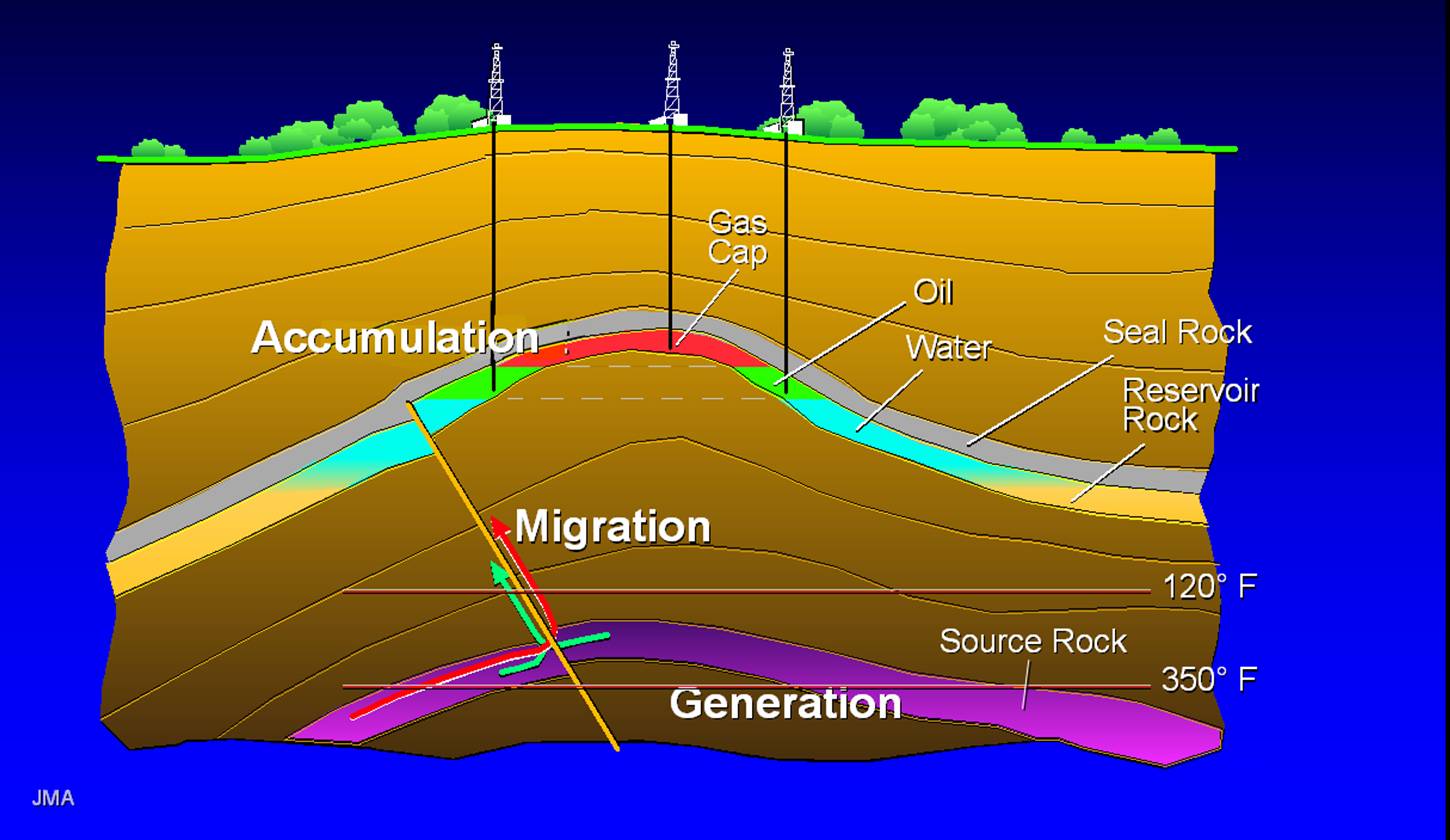
http://smiatmiundip.files.wordpress.com/2011/05/migrasi.jpg
Mechanism (of the figure)
Source rock which has organic material (planctonic, algae, etc) produce the oil because the temperature make it mature. Then the oil moves into reservoir through the fault and fill the pore (migration). Then after the migration happens, it will be trapped and accumulated. The density of oil < density of water, accordingly oil always on the top of the water. When the oil reach the specific point, it will be gas.
Why the oil/gas not leak to the surface?
Why the oil/gas not leak to the surface?
Because the top of reservoir rock, there are seals rock. Seal consist of impermeable rock, usually claystone. and the top of seal named overburden rock.
Trap
There are kinds of oil/gas trap
Structural Trap : formed by a deformation in the rock layer that contains the hydrocarbons. There are salt dome, fold, and fault trap. Structural traps are the easiest to locate by surface and subsurface geological and geophysical studies. They are the most numerous among traps and have received a greater amount of attention in the search for oil than all other types of traps.
- Salt Dome Trap : Intrusion of salt because of differential density of rock layer and salt. Salt will tends cut the top layer on it. Then, it makes a trap for oil accumulation.
http://www.cartografareilpresente.org/local/cache-vignettes/L300xH232/Salt_dome_trap-42877.jpg
- Fold Trap : Compression of tectonics make rock layers folded and forms sincline and anticline. Anticline is the best trap, because the drilling process is relatively easy. The oil and gas move to the top because pressure, and drilling started on the topper of anticline because of eficiency height.

3. Fault Trap : Trap formed by fault (look at the figure on top), and the oil could not to moves because there was impermeable layer
Stratigraphic Trap : formed when other beds seal a reservoir bed or when the permeability changes (facies change) within the reservoir bed itself. Stratigraphic traps can form against either younger or older time surfaces.
Source :
http://en.wikipedia.org/wiki/Petroleum_geology
http://en.wikipedia.org/wiki/Petroleum_reservoir
keywords : Petroleum system, trap, reservoir, source rock, structural trap, seal rock, petroleum geology, migration, fault
November 27, 2011
Geokimia Minyak & Gas Bumi
Geokimia Minyak & Gas Bumi merupakan aplikasi dari ilmu kimia yang mempelajari
tentang asal, migrasi, akumulasi serta alterasi minyak bumi (John M. Hunt, 1979).
Petroleum biasanya juga diartikan minyak dan gas bumi yang memiliki komposisi kimia
berupa Carbon dan Hidrogen. Komposisi kimia ini dihasilkan dari proses pembusukan
(dekomposisi) serta kematangan termal material organik.
Material organik tersebut berasal dari tumbuh2an dan algae. Material organik ini ketika
mati segera diendapkan. Akibat adanya suhu, tekanan serta waktu yang cukup, komponen2
tumbuhan dan algae teralterasi menjadi minyak, gas dan kerogen. Kerogen dapat dianggap
sebagai material padat sisa tumbuhan.
Shale dan Limestone yang mengandung material organik disebut sebagai source rock
karena batuan tersebut merupakan batuan sumber untuk menghasilkan minyak & gas bumi.
Analisis Geokimia dalam dunia perminyakan tersebut bertujuan untuk :
a. Untuk mengidentifikasi source rock dan menentukan jumlah, tipe, dan tingkat
kematangan material organik
b. Mengevaluasi perkiraan kapan migrasi minyak & gas bumi dari source rock
c. Memprediksi jalur migrasi
d. Korelasi komposisi minyak & gas bumi yang berada di dalam reservoar, rembesan
(seeps) untuk mengetahui keberadaannya.
Kebanyakan analisis geokimia menggunakan isotop stabil ; analisis hidrokarbon untuk
material organik yaitu dengan Gas Chromatography (GC) dan Gas Chromatography – Mass
Spectrometry (GC-MS) ; indikator kematangan menggunakan Vitrinite Reflectance (%Ro) ;
pirolisis dan analisis ; tipe kerogen.
Selengkapnya download disini
tentang asal, migrasi, akumulasi serta alterasi minyak bumi (John M. Hunt, 1979).
Petroleum biasanya juga diartikan minyak dan gas bumi yang memiliki komposisi kimia
berupa Carbon dan Hidrogen. Komposisi kimia ini dihasilkan dari proses pembusukan
(dekomposisi) serta kematangan termal material organik.
Material organik tersebut berasal dari tumbuh2an dan algae. Material organik ini ketika
mati segera diendapkan. Akibat adanya suhu, tekanan serta waktu yang cukup, komponen2
tumbuhan dan algae teralterasi menjadi minyak, gas dan kerogen. Kerogen dapat dianggap
sebagai material padat sisa tumbuhan.
Shale dan Limestone yang mengandung material organik disebut sebagai source rock
karena batuan tersebut merupakan batuan sumber untuk menghasilkan minyak & gas bumi.
Analisis Geokimia dalam dunia perminyakan tersebut bertujuan untuk :
a. Untuk mengidentifikasi source rock dan menentukan jumlah, tipe, dan tingkat
kematangan material organik
b. Mengevaluasi perkiraan kapan migrasi minyak & gas bumi dari source rock
c. Memprediksi jalur migrasi
d. Korelasi komposisi minyak & gas bumi yang berada di dalam reservoar, rembesan
(seeps) untuk mengetahui keberadaannya.
Kebanyakan analisis geokimia menggunakan isotop stabil ; analisis hidrokarbon untuk
material organik yaitu dengan Gas Chromatography (GC) dan Gas Chromatography – Mass
Spectrometry (GC-MS) ; indikator kematangan menggunakan Vitrinite Reflectance (%Ro) ;
pirolisis dan analisis ; tipe kerogen.
Selengkapnya download disini
Subscribe to:
Posts (Atom)